Parkinsonia Di-Bak project
Parkinsonia (Parkinsonia aculeata) is one of Australia's Weeds of National Significance and a Class-B declared weed in the Northern Territory. It is estimated to infest around one million hectares nationally and threatens agricultural productivity and environmental values across much of the Australian mainland. Parkinsonia forms dense, impenetrable thickets that restrict access for people and livestock, impede mustering operations, limit stock access to water, displace native flora and fauna, alter water flows and provide harbour for feral animals.
In the Barkly region, parkinsonia poses a significant threat to wetlands and floodplains by obstructing watercourses, lowering water tables, and colonising extensive areas of seasonally inundated country. Vulnerable areas include nationally and internationally significant wetlands and seasonal lake systems.
Supporting biological control efforts
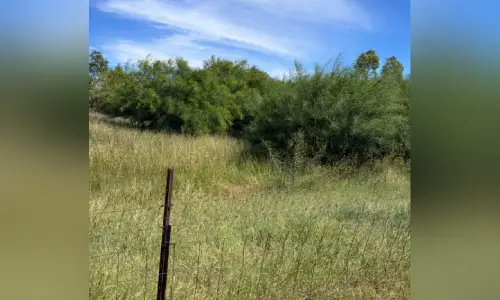
Weeds officers from Alice Springs have been assessing known parkinsonia infestations across the Alice Springs and Barkly regions to identify suitable sites for Parkinsonia Di-Bak bioherbicide distribution. The fungal pathogens used in Di-Bak were originally isolated from parkinsonia populations in the north-eastern Barkly and have demonstrated promising results under local conditions. The current project aims to support landholders and managers in the drier environments of Central Australia, the southern Barkly and parts of the Katherine region, to control parkinsonia populations.
Parkinsonia Di-Bak bioherbicide was developed over a period of 15 years by researchers at the University of Queensland using naturally occurring fungal pathogens that specifically targets parkinsonia. The product is commercially available in capsule form and contains 3 active pathogens. As a biological control agent, it offers advantages for organic and environmentally sensitive properties, providing long-term suppression without the need for repeated chemical applications.
This year, the Weed Management Branch made Parkinsonia Di-Bak bioherbicide available to landholders and land managers in the regions to assist with the control of parkinsonia on their properties. Landholders received the bioherbicide along with advice on its use and were then responsible for distributing and monitoring it on their properties.
Biocontrol in action
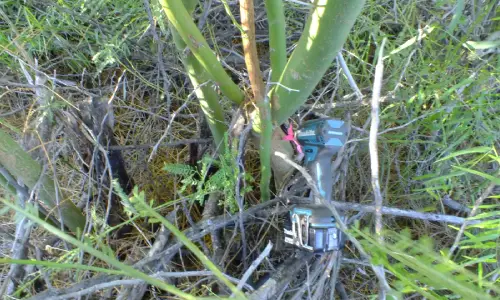
To date, Weeds Officers have overseen the establishment of 8 biocontrol release sites across 3 properties, with additional sites planned on 5 more properties before the onset of the wet season. Each release site is located within the upper reaches of the drainage system and includes 10 treated parkinsonia trees. Treatment involves drilling an 8 mm hole into the trunk, inserting a Di-Bak capsule, and sealing the opening with a wooden plug.
A key advantage of Parkinsonia Di-Bak is that it consists of living fungal pathogens rather than chemical herbicides. Once established, the fungi can persist in the environment and spread through the soil, infecting nearby parkinsonia plants as they emerge. This provides ongoing background control and has the potential to reduce the need for follow-up treatments, improving the long-term management of parkinsonia infestations.