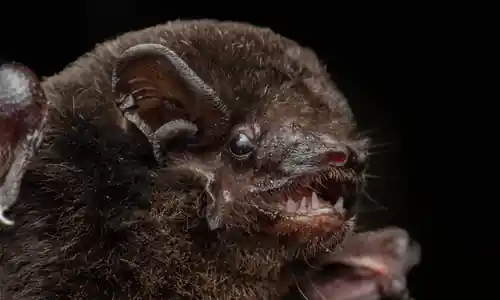
New bat species confirmed for northern Australia
A collaborative study involving the Flora and Fauna Division has confirmed the presence of a new bat species for Australia, here in the Top End. The coastal wattled bat (Chalinolobus orarius) has officially been added to Australia’s mammal list, following re examination of specimens held at the Northern Territory Museum.
Interestingly, this new species was first suspected more than 20 years ago. Since 2000, surveys conducted by the Flora and Fauna Division noticed that some bats from northern Australia looked slightly different from Gould’s Wattled Bat, a common species found across Australia. These bats were smaller, darker and had a difference echolocation call frequency - but without clear diagnostic features their identity remained unresolved.
The picture changed recently when the coastal wattled bat was formally described as a new species in Papua New Guinea. This new bat was similar in size and appearance to the unusual bat we observed in the Top End, living in low-lying coastal habitats. This raised the possibility that the same species might also occur in northern Australia, given the similar environments and relatively close geographic proximity.
A newly identified physical feature provided the evidence we were after. The coastal wattled bat has a small but distinctive tooth characteristic not seen in other similar bats. When we checked specimens held at the Northern Territory Museum, several bats matched this feature exactly. Their size and other physical traits also closely matched the Papua New Guinea specimens.
These finding confirmed that the coastal wattled bat occurs in Australia. All confirmed records so far come from low lying coastal areas of the Northern Territory, within five kilometres of the coastline, particularly in mangrove habitats and nearby open woodland.
At this stage, the species appears to be uncommon or rare in Australia. However, this may be partly because the bat has been overlooked or mistaken for other species in the past. More targeted surveys will be needed to understand how widespread it is and whether it may require conservation attention.
For more information, read the paper in Australian Mammalogy on the CSIRO Publishing ConnectSci website.