NT Weed Management Branch combats rubber vine threat
The NT Weed Management Branch has pooled resources from across the regions to tackle the growing threat of rubber vine spreading into the Territory.
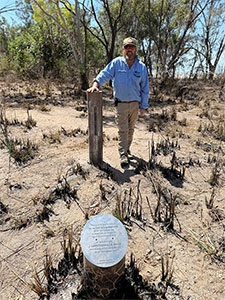
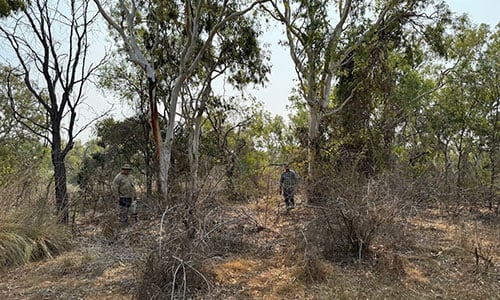
A 2-week survey and control program was carried out in a remote area of the Territory, along the Northern Territory–Queensland border. The program aimed to detect infestations early and prevent the invasive weed from taking hold. It forms part of an Australian Government funded project ‘Protecting country: survey and control of rubber vine in the Gulf of Carpentaria.’
The team, which included staff from Alice Springs, Tennant Creek and Katherine, worked with the landowner to manage satellite infestations of rubber vine located on the property.
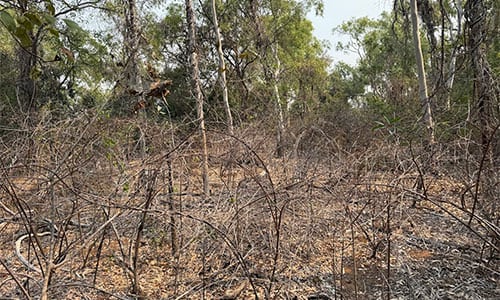
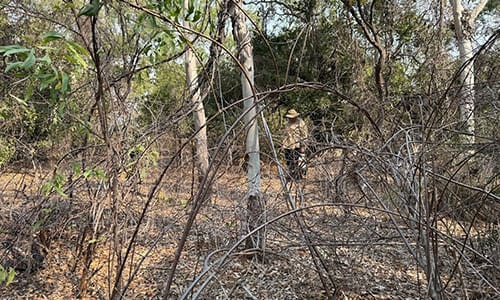
Rubber vine (Cryptostegia grandiflora) is regarded as one of Australia’s worst invasive weeds. It forms dense thickets that smother native vegetation, restricts access to water and reduces biodiversity. Heavy infestations can severely limit grazing by overtaking pastures and makes mustering difficult.
The seeds are spread primarily by wind and water, including within saltwater, and once an infestation is established it can be incredibly difficult to control.
Rubber vine is a category 1 priority weed for eradication in the Darwin and Katherine regions, a class A weed (to be eradicated) in the NT under the Weeds Management Act 2001, and a Weed of National Significance in Australia.
In keeping with these national and NT listings, the branch is working with landholders to eradicate all rubber vine from within the NT and reduce the risk of spread from Queensland. This is important to protect the ecologically and economically important Gulf Country and prevent significant future costs incurred if rubber vine were allowed to gain a foothold in the Territory.
If rubber vine were to spread widely into the Territory, it could cause significant environmental, cultural, and economic impacts, threatening healthy landscapes, pastoral productivity, and the cultural values that Traditional Owners and local communities rely on.
Ongoing surveillance and cross-border cooperation are crucial for keeping rubber vine out of the Territory. The branch recently attended the 2025 Northern Australia Indigenous biosecurity ranger forum in Burketown, Queensland, to discuss working in cooperation across the border to reduce the risk of rubber vine spreading into the Territory.
Extensive surveys will be conducted between the border and McArthur River in early 2026 to identify any new incursions.
Early detection and rapid response remain the most effective strategies to stop this invasive weed from establishing a foothold.