Enhancing accountability – Auditing onshore petroleum environmental compliance
The Department of Lands, Planning and Environment (DLPE) is continuing its commitment to protecting the Territory’s environment by undertaking proactive audits of the onshore petroleum industry.
A formal environmental compliance audit was recently carried out with the Office of the Supervising Scientist from the Commonwealth Department of Climate Change, Energy, the Environment and Water in a cross-government collaboration to confirm how operators put environmental commitments into action on the ground.
This approach has set a strong benchmark for responsible petroleum operations in the Northern Territory.
The audit was conducted under the statutory requirements of the Petroleum Act 1984 and the Petroleum (Environment) Regulations 2016, Code of Practice, and was conducted in line with AS/NZS ISO 19011: Guidelines for Auditing Management Systems.
The audit formed part of DLPE’s routine compliance monitoring program to ensure that onshore petroleum activities in the Northern Territory meet high standards of environmental protection and that all regulatory commitments are met.
Operators, known formally as interest holders, operate under approved Environment Management Plans (EMP). This critical document sets out how interest holders must manage key environmental risks such as wastewater, drilling waste, chemical storage, flowlines, bunding, rehabilitation, pits and sumps, and spill response.
The audit focused on assessing whether drilling activities and storage of chemicals complied with the conditions set in the EMP which covered multiple well pads in the Beetaloo Sub-basin.
What we did
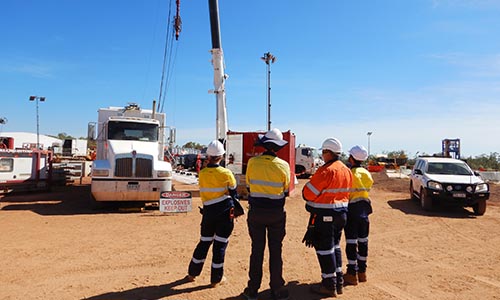
Over two days, a dedicated audit team visited several well pads to assess how EMP commitments were being implemented. The audit included:
- desktop reviews of key EMP commitments, spill management plans, and operational records
- onsite inspections at the well pads to verify infrastructure and operational practices
- interviews with site personnel to clarify and validate procedures, training, and management practices
- verification of records including inspection logs, training records, induction materials, and telemetry data
- collection of photographic evidence and field notes to support findings.
Outcomes
This collaborative audit provided valuable insights for both the regulator and the operator. It strengthened our understanding of how environmental commitments are applied in practice and identified opportunities to improve performance across the industry.
Early engagement with the interest holder helped ensure transparency and alignment on audit expectations. A notable challenge was assessing compliance with certain imprecise EMP commitments. This revealed a need for EMP commitments to be articulated in clearer, outcome-focused language to support effective auditing.
Following the onsite audit activities, a comprehensive list of key findings including any non-compliances, conditional findings, and observations was compiled and provided to the interest holder. The audit team outlined specific actions required to address each finding, including clear timeframes for implementing corrective measures and submitting evidence of close-out.
Any items requiring further verification will be monitored through DLPE’s routine compliance program. Where necessary, targeted follow-up audits will be conducted to confirm that corrective actions have been completed.